

Newsletter
Sign Up And Receive Our Latest Updates!

.svg)
Events
Sakai and Wellington, Turning Sister City Ties into Practical Startup Collaboration
Innovation Dojo Japan recently supported the Sakai–Wellington Startup Cross-Border Online Exchange, bringing together Sakai City Government, Wellington’s Creative HQ and two mission-driven startups working at the intersection of healthcare, care services and public systems.
The session was designed to get practical, to hear directly from founders working on real social challenges, and to test whether a sister city relationship can become a platform for pilots, partnerships and measurable impact.
How Sakai and Wellington Are Building Innovation Ecosystems
Sakai City, located in Japan’s Kansai region, has a strong industrial identity, deep manufacturing capability and a growing focus on startup support through incubation and acceleration initiatives. The city’s approach reflects a wider shift in Japan, where local governments are increasingly expected to create pathways for innovation that connect industry, community needs and emerging technology.
Sakai City also shared a clear model of locally led innovation ecosystems, built through community connection, nurturing future generations, long-term entrepreneur support, place-based clustering, and continuous collaboration.
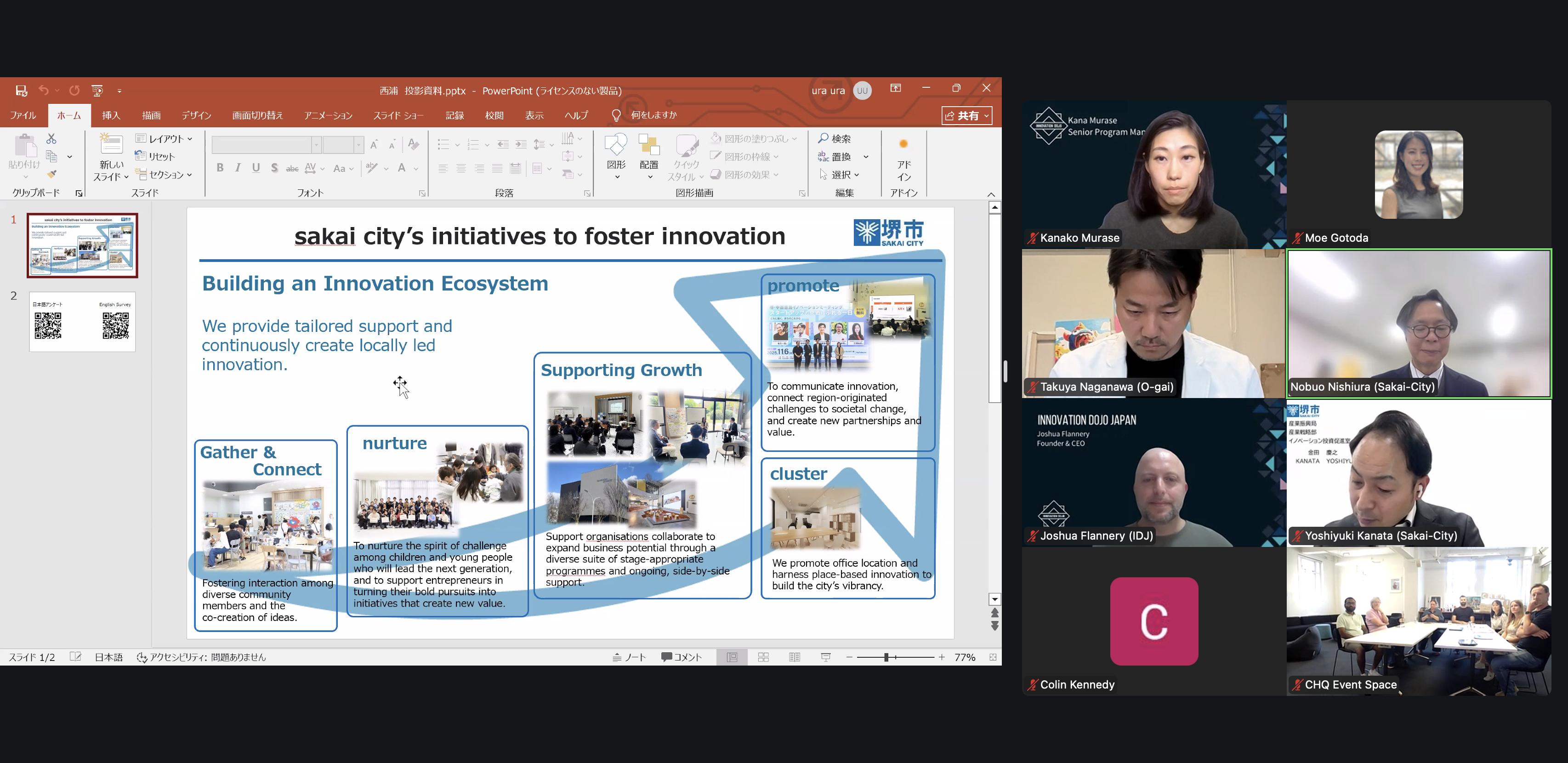
Wellington, New Zealand’s capital, is smaller in population but highly concentrated in policy, public institutions and national decision-making. This was discussed as an advantage for building relationships, influencing reform and running initiatives that depend on regulation and long-term programmes.
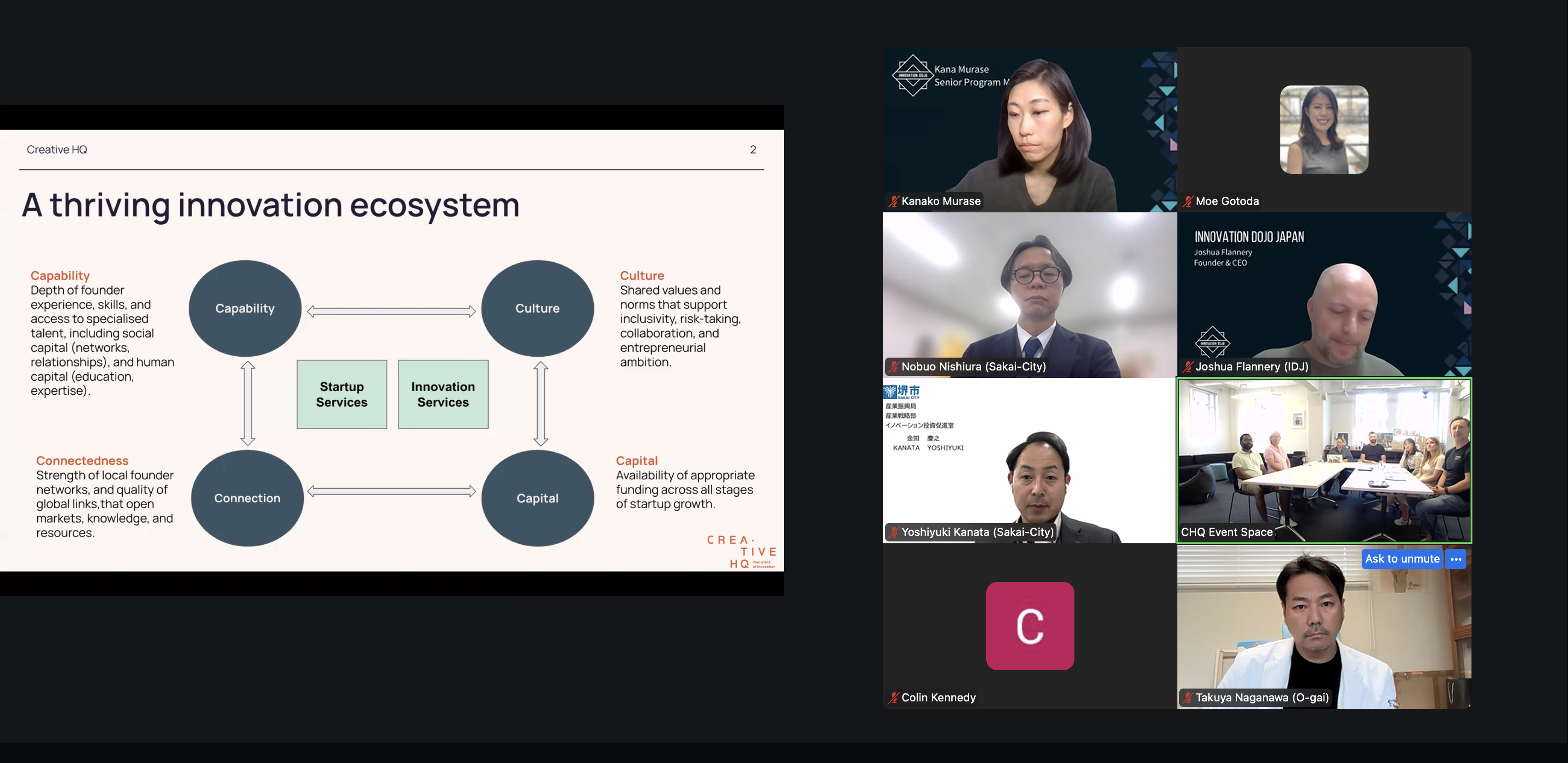
From Wellington, Creative HQ presented its role in building Wellington’s startup ecosystem and introduced the 4Cs framework, Capability, Culture, Connectedness and Capital. The organisation also noted its international operations across New Zealand, Australia, Fiji and Papua New Guinea and expressed interest in deepening ties with Sakai and Kansai.
Two startups, two angles on care and dignity
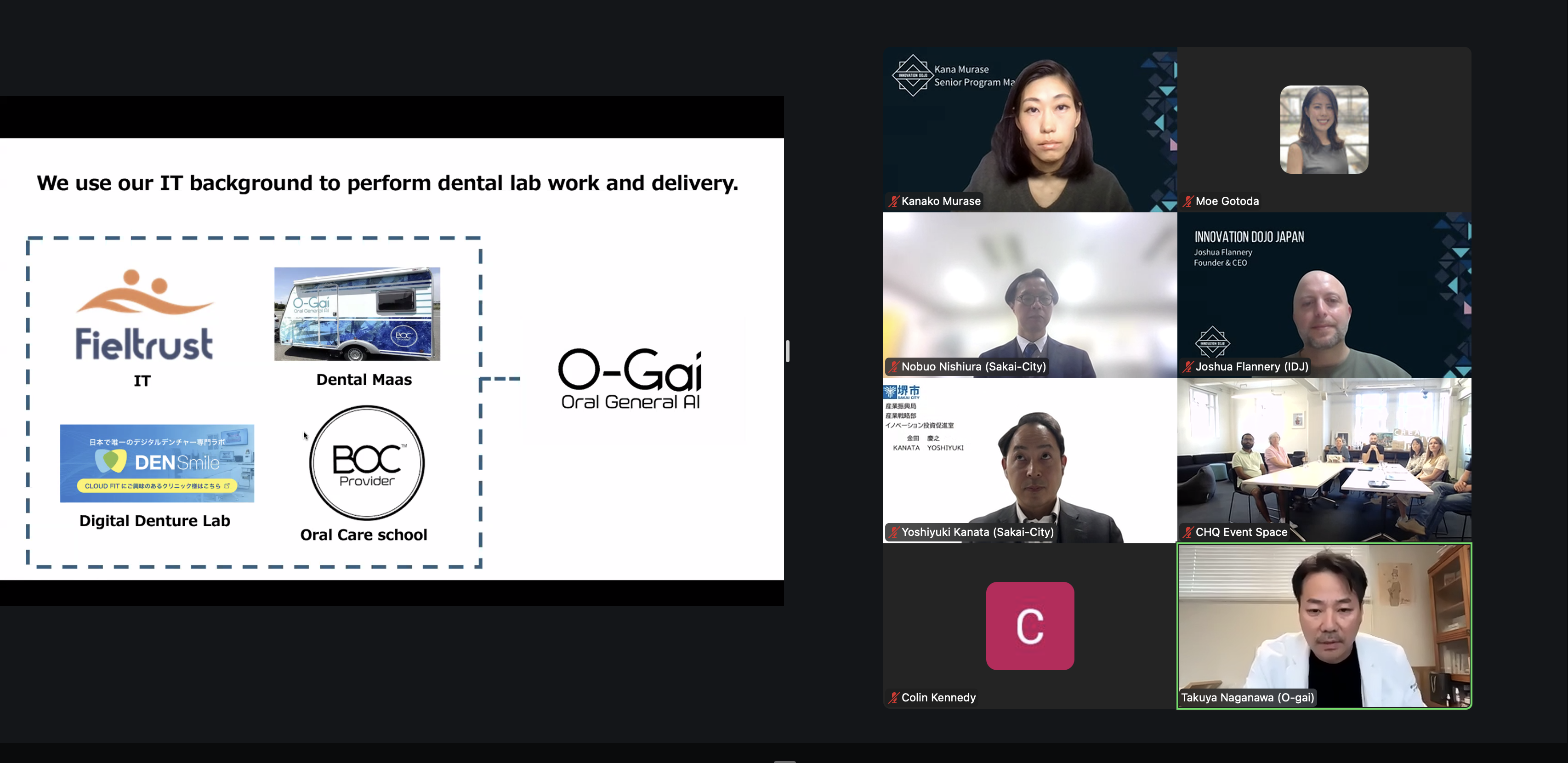
From Sakai, Dr Takuya Naganawa, CMO of O-gai, introduced a dental business built around 3D scanning and 3D printing. The service includes mobile equipment designed for disaster situations and remote areas where conventional access to care is limited.
Japan and New Zealand were described as sharing similar pressures, both as island nations experiencing natural disasters and challenges in regional healthcare delivery. Collaboration ideas raised during the session included collecting patient data in aged-care facilities for disaster preparedness, enabling technicians in Japan to design dental solutions that could be produced in New Zealand and creating exchange opportunities for dental specialists to share skills.
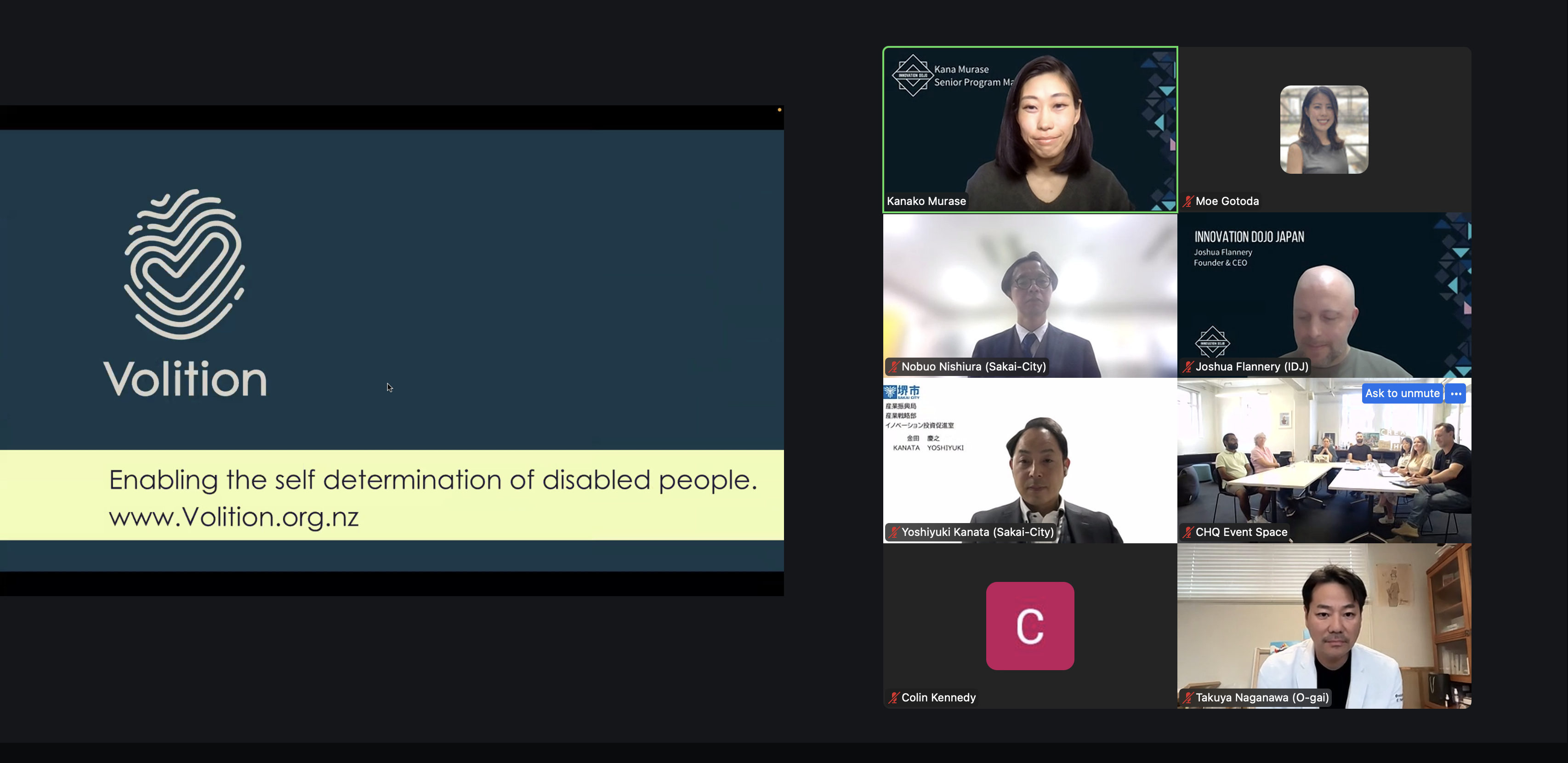
From Wellington, Erica Butters, Founder and CEO of Volition, presented a platform that enables disabled people to record and communicate their preferences to support self-determination. Drawing on her experience in disability advocacy, she described systemic problems such as people needing to repeatedly explain themselves across services, high workforce turnover among carers and families relying on paper records to document communication styles and personal priorities.
Volition was positioned as a digital preference bank where users can store information through text, photos, audio or video, decide what is shared and involve parents or collaborators. The company completed Creative HQ’s accelerator programme, raised pre-seed funding and is currently working with ten partner agencies in New Zealand reaching more than 120,000 people, while preparing to expand into Australia and aged care services.
Panel Discussion, Shared Challenges and Collaboration Potential
Facilitated by Innovation Dojo Japan CEO Joshua Flannery, the panel discussion examined how startups confront social challenges shaped by policy and institutions, and how Sakai and Wellington can collaborate through pilot driven approaches.
Common Challenges Across Both Cities
Through the discussion, several shared pressures became clear:
- Social challenges becoming politicised
- Deep structural bias around disability and inclusion
- Institutional inertia slowing change
- The limits of startup led action without broader system alignment
Panelists also noted that founders tackling social challenges often take on roles beyond product development, including advocacy and sustained engagement with government.
Perspectives for Collaboration
In response to these realities, three key viewpoints were emphasised.
- Human rights before geography
Defining problems at a human level creates global relevance and avoids limiting solutions to local market or regulatory structures. - Technology as an enabler, not the answer
Digital tools such as remote data sharing and distributed design help bridge distance, but they cannot replace trust, relationships or institutional alignment - Collaboration as real infrastructure
Public institutions, startups, community groups, support organisations and governments depend on one another. Technology is the tool, collaboration is the engine.
What a sister city relationship can enable
The session highlighted a practical advantage of sister city ties, they can reduce friction and create a natural reason to collaborate across public institutions and ecosystem intermediaries. A question from the audience raised a real-world issue: Wellington is roughly a quarter the population size of Sakai. The response was grounded and practical, start with small-scale pilots with clear boundaries, learn what works, then scale beyond the pilot once the pathway is clearer.
Several straightforward collaboration approaches were discussed:
- Use existing relationships to introduce the other startup into relevant agencies and providers
- Avoid overcomplicating the first step
- Design pilots that fit real operational conditions in each location
The exchange framed the Sakai–Wellington relationship as a trusted corridor where testing, learning and adaptation can happen more easily before broader expansion.
Where this goes next
The session marked the beginning of a longer journey toward practical, action-oriented collaboration between Sakai and Wellington.
Innovation Dojo Japan looks forward to continuing to support this process and helping translate dialogue into real-world outcomes across the Asia-Pacific region.
Big thanks to Sakai City Government, Creative HQ and the founders who shared their work so openly in making this cross-border exchange possible!

Latest Posts


Copyright 2022 innovation Dojo Japan LLC. All rights reserved.
Buy Template | Version 1.1 | Image Licensing | Made By Pablo Ramos | Visit My Templates | Powered By Webflow